
DyNAMO
Dynamic Navigation & Autonomous Manipulation Operations
DyNAMO divides an autonomous robotics system into three connected parts: ROS 2 navigation for the Ridgeback mobile base, learned manipulation for the Unitree G1, and a shared Isaac Sim and Isaac Lab environment built with USD. Defined interfaces allow each subsystem to be developed independently before integration.
DyNAMO
Dynamic Navigation & Autonomous Manipulation Operations
Robotics system architecture
Navigation, manipulation, and simulation under shared interfaces
The Ridgeback handles mapping, path planning, obstacle avoidance, and docking. The G1 manipulation track studies learned pick-and-place policies, while the simulation track supplies shared robot assets, physics, environments, and synthetic data.
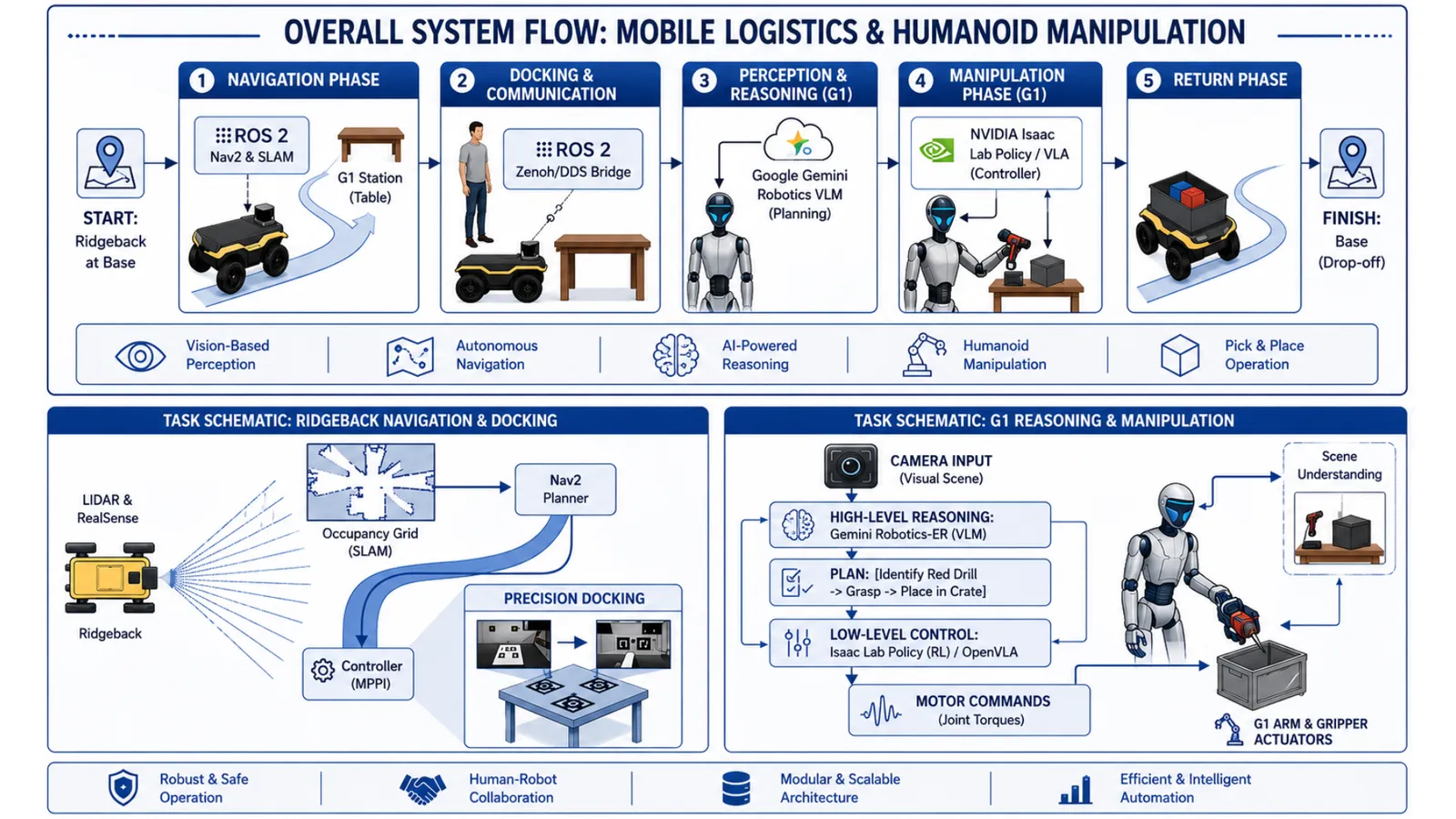
How the DyNAMO system is divided
The mobile-navigation track uses ROS 2 Nav2 for mapping and autonomous movement, then adds visual servoing and dynamic obstacle handling for precise positioning near the manipulator.
The manipulation track compares foundation models, imitation learning, vision-language-action models, and code-as-policy approaches. A shared Isaac Sim and Isaac Lab environment uses USD stages, digital twins, physics, and synthetic data to keep both robot subsystems compatible before hardware transfer.
Technical focus
Implementation details
- ROS 2 navigation handles mapping, path planning, obstacle avoidance, and mobile-base docking
- Learning-based manipulation targets multi-object pick-and-place with the Unitree G1
- Shared USD stages combine robot assets, physics, and synthetic-data generation in Isaac Sim and Isaac Lab
Technical project document
The document describes the subsystem interfaces, navigation and manipulation tracks, Isaac simulation environment, and intended integration workflow.