
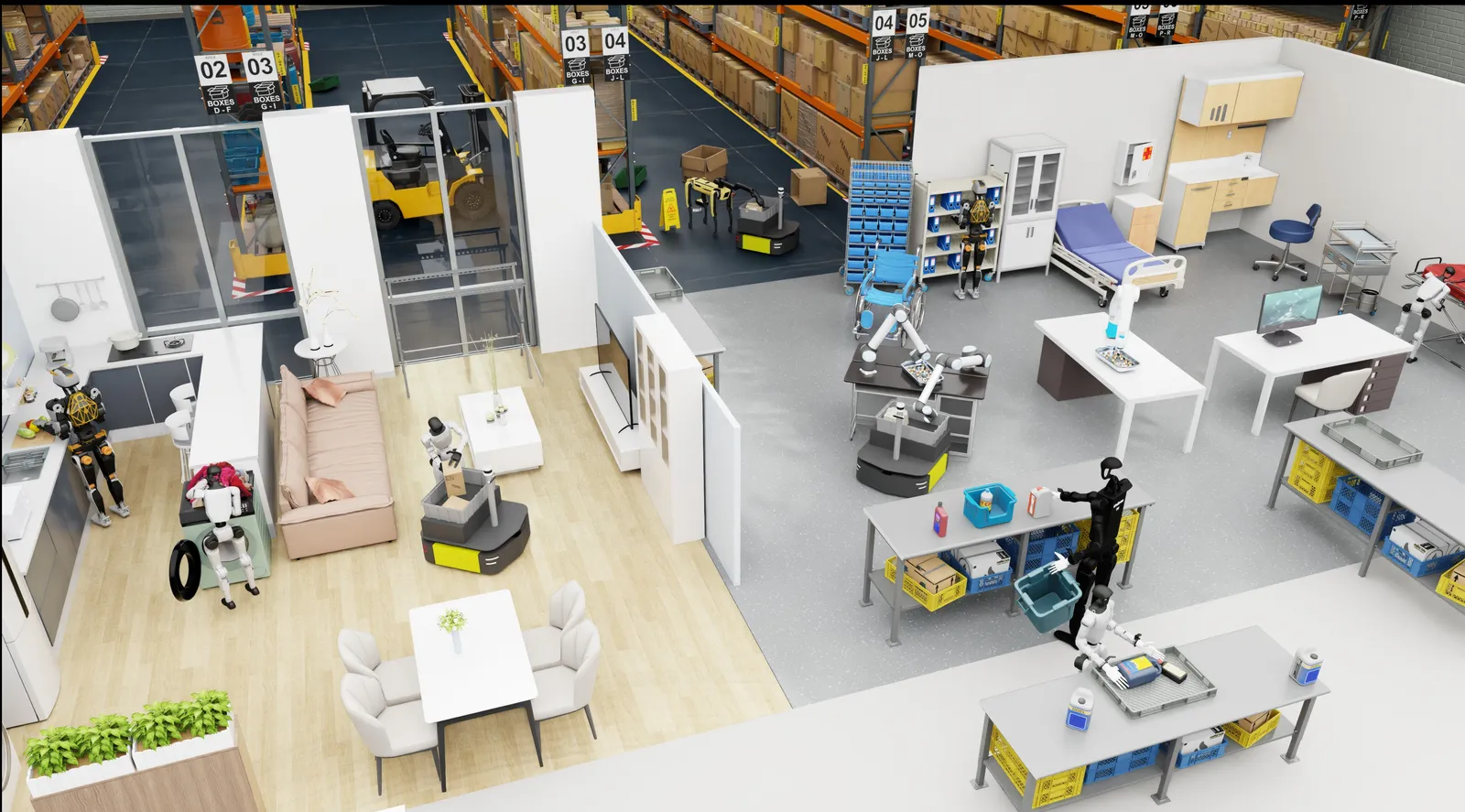
DyNAMO
DyNAMO advances cognitive robotics by bridging perception, reasoning, and action — an integrated framework for dynamic navigation and manipulation, carried from simulation through to real hardware.
A cognitive robotic system built to adapt to unstructured environments and learn through interaction. It pairs foundation-model reasoning with classical navigation and control to reach versatile, robust behavior in real-world settings.
Objective
Integrate navigation, manipulation, and reasoning
Dynamo demonstrates an integrated system where a humanoid robot identifies, grasps, and places objects while working with an autonomously navigating mobile base. The core challenge is Sim2Real transfer: behavior developed in simulation must survive the noise and constraints of physical operation.
Research question
Can navigation and manipulation developed in simulation transfer to real hardware as one integrated system — and how reliably does each subsystem hold up under physical conditions?
Experiment log
Towel pick and place on three-finger hands
The same pipeline runs on a soft, deformable object, a towel, with the G1 fitted with three-finger Dex3 hands. The simulation only ever modelled two-finger hands, so the policy has never seen this hand. The clip is shortened and sped up 1.5 to 2 times.
Outcome·The G1 picks the towel up and drops it into a box with no fine-tuning for the new hand: a zero-shot transfer to three fingers. It does not hold for every task. The cube task does not transfer zero-shot to the three-finger hand.
Milestones
12/12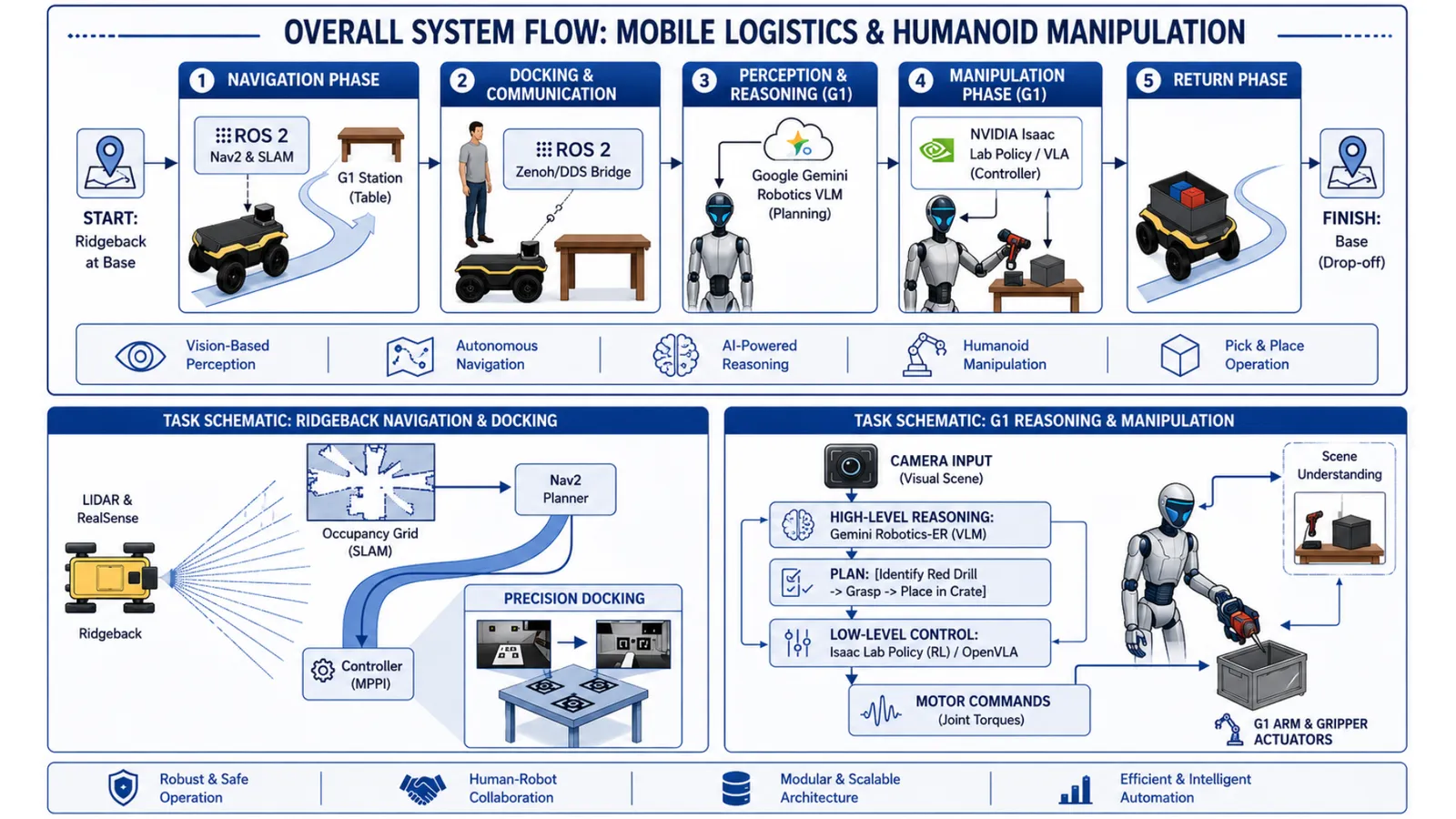
Mobile base
Nav2 + explorationRidgeback navigation
Mapping · Path planning · Hardware-facing runs
Manipulator
Teleop + policy interfaceUnitree G1 control
Command timing · Safety boundaries · Manipulation trials
Simulation
Repeatable test scenesIsaac Lab pipeline
USD environments · Synthetic scenarios · Sim2Real validation
Integration
Mobility + manipulationInterface contracts
Scene state · Perception links · Evidence loop