
Conferences 2025

CORE at ICLR and ICSE 2025

Papers authored or co-authored by CORE members, accepted at the main conferences and workshops of the 2025 International Conference on Learning Representations (ICLR) in Singapore and the 2025 International Conference on Software Engineering (ICSE).

ICLR Main Conference

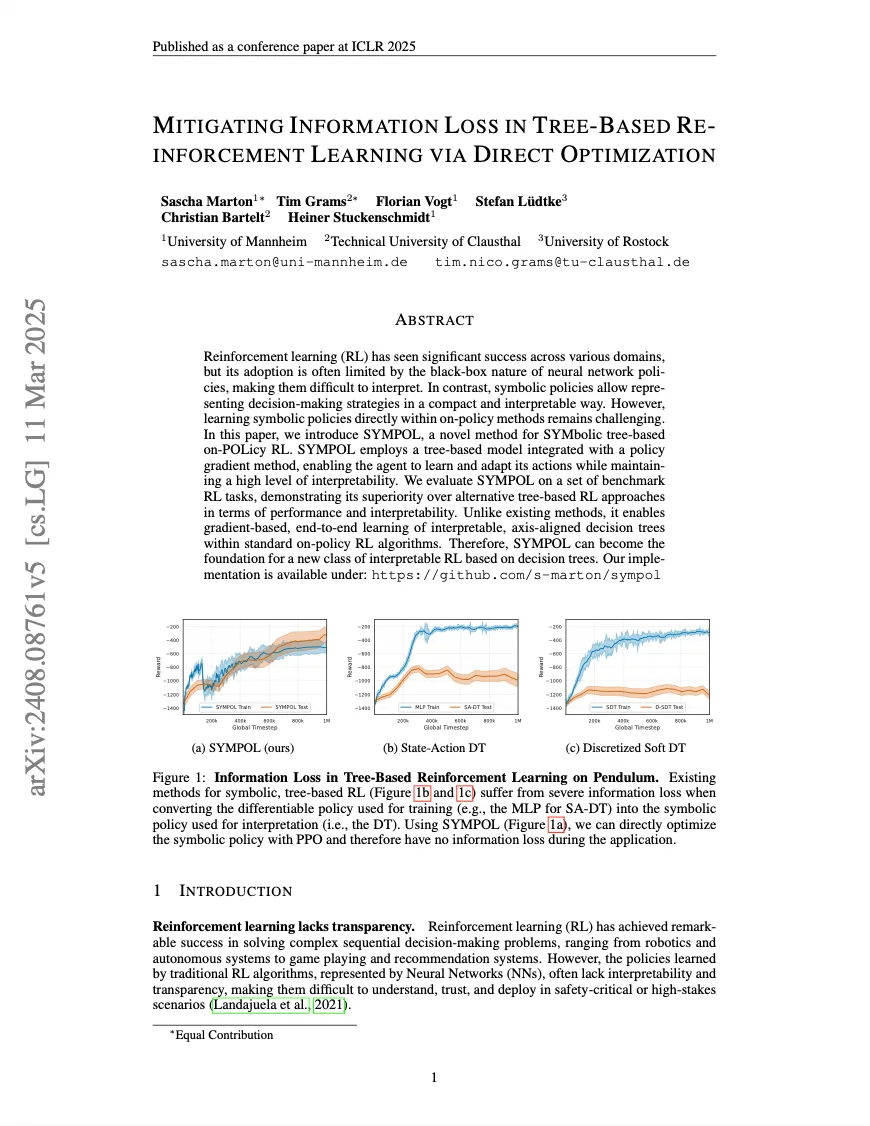
Mitigating Information Loss in Tree-Based Reinforcement Learning via Direct Optimization

  • University of Mannheim
  • TU Clausthal
  • University of Rostock

The paper introduces SYMPOL, a method that integrates symbolic, tree-based models with policy gradient methods to make reinforcement learning more interpretable. By enabling direct, end-to-end optimization of axis-aligned decision trees within standard on-policy RL algorithms, SYMPOL addresses the information loss associated with traditional neural network policies.

Read the paper
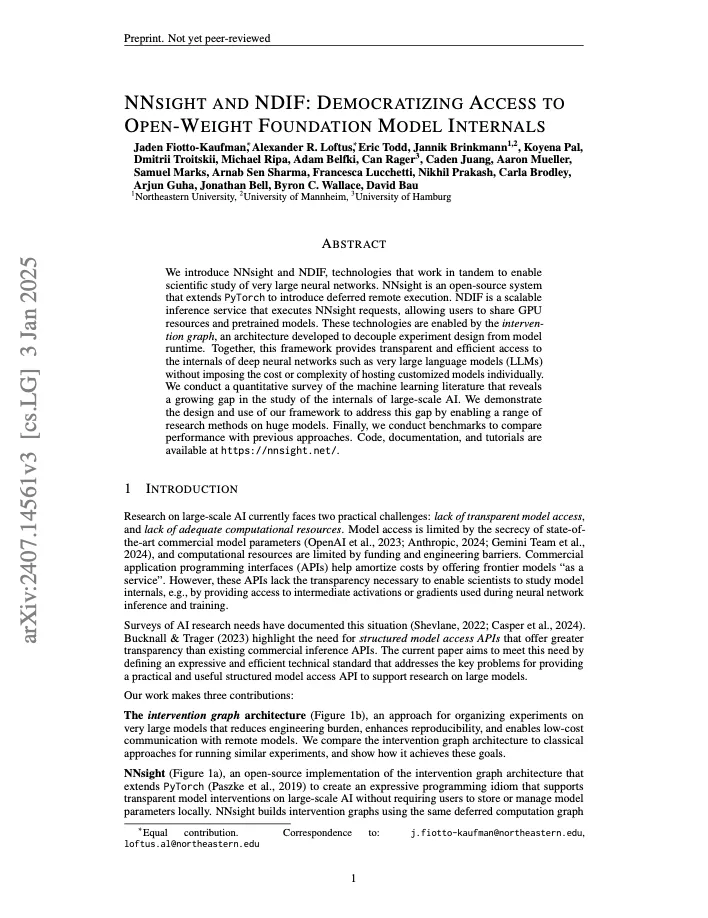
NNsight and NDIF: Democratizing Access to Open-Weight Foundation Model Internals

  • Northeastern University
  • TU Clausthal
  • University of Hamburg

The paper introduces NNsight, an open-source extension to PyTorch enabling deferred remote execution, and NDIF, a scalable inference service for sharing GPU resources and pretrained models. Together, they give transparent access to the internals of large neural networks, such as large language models, without each group having to host customized models.

Read the paper

ICSE Main Conference

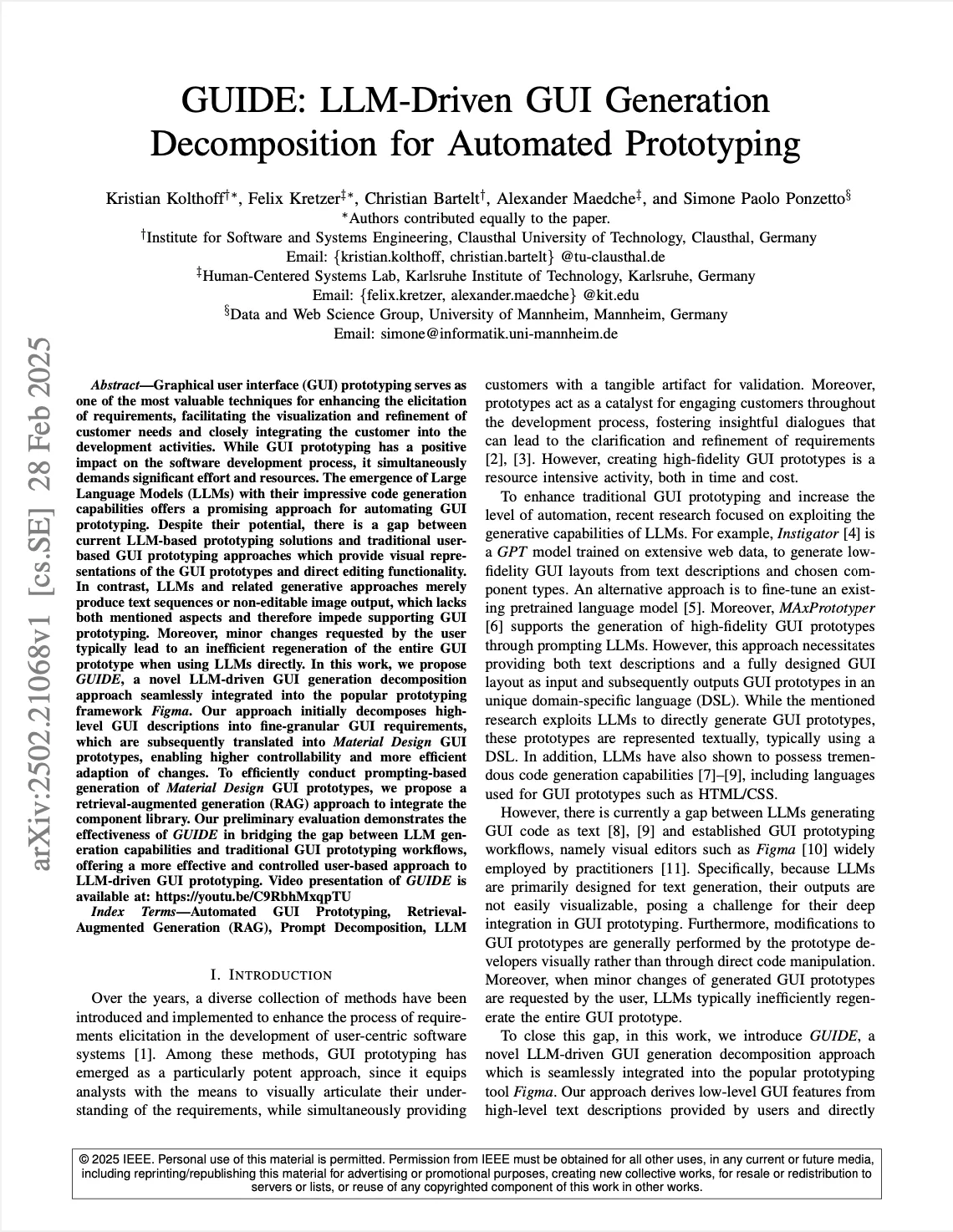
GUIDE: LLM-Driven GUI Generation Decomposition for Automated Prototyping

  • TU Clausthal
  • Karlsruhe Institute of Technology
  • University of Mannheim

The paper introduces GUIDE, an approach that uses large language models to automate the generation of graphical user interface prototypes by decomposing high-level textual descriptions into fine-grained GUI requirements. Integrated with the prototyping tool Figma, GUIDE uses retrieval-augmented generation to translate these requirements into editable Material Design components, which improves controllability and streamlines prototyping.

Read the paper

ICLR Workshops

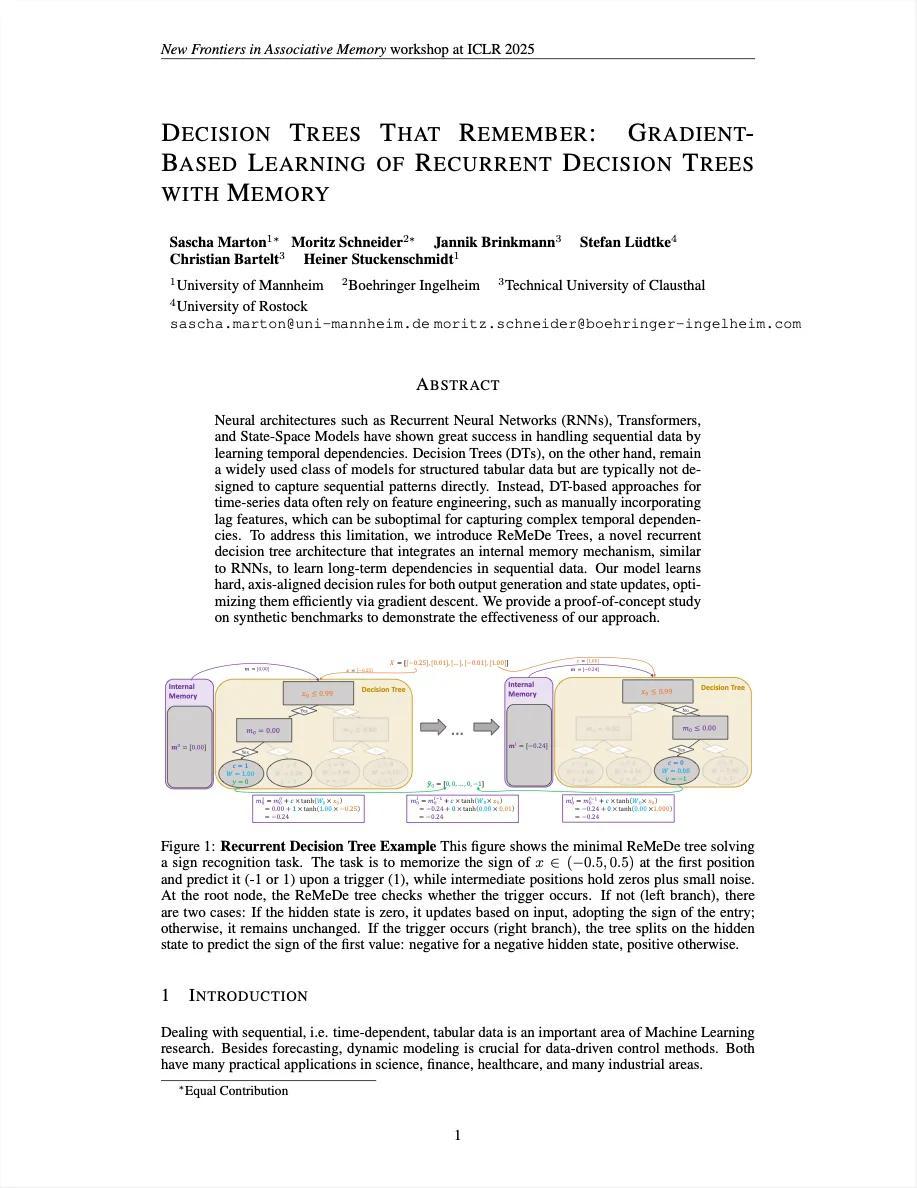
Decision Trees That Remember: Gradient-Based Learning of Recurrent Decision Trees with Memory

  • University of Mannheim
  • Boehringer Ingelheim
  • TU Clausthal
  • University of Rostock

The paper introduces ReMeDe Trees, a decision tree architecture for sequential data with an internal memory mechanism akin to that of recurrent neural networks. Unlike traditional decision trees, which rely on feature engineering to capture temporal dependencies, ReMeDe Trees learn hard, axis-aligned decision rules for both output generation and state updates, optimized efficiently via gradient descent.

Read the paper

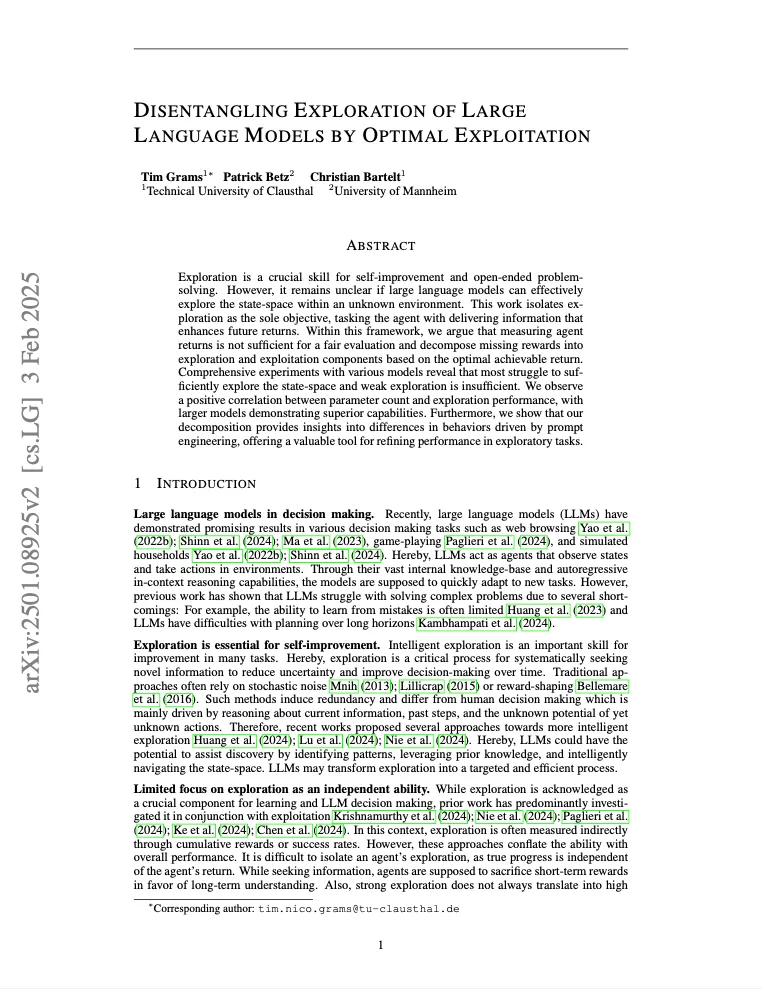
Disentangling Exploration of Large Language Models by Optimal Exploitation

  • TU Clausthal
  • University of Mannheim

The paper investigates the exploration capabilities of large language models by isolating exploration as the sole objective and introducing a framework that decomposes missing rewards into exploration and exploitation components, based on the optimal achievable return.

Read the paper

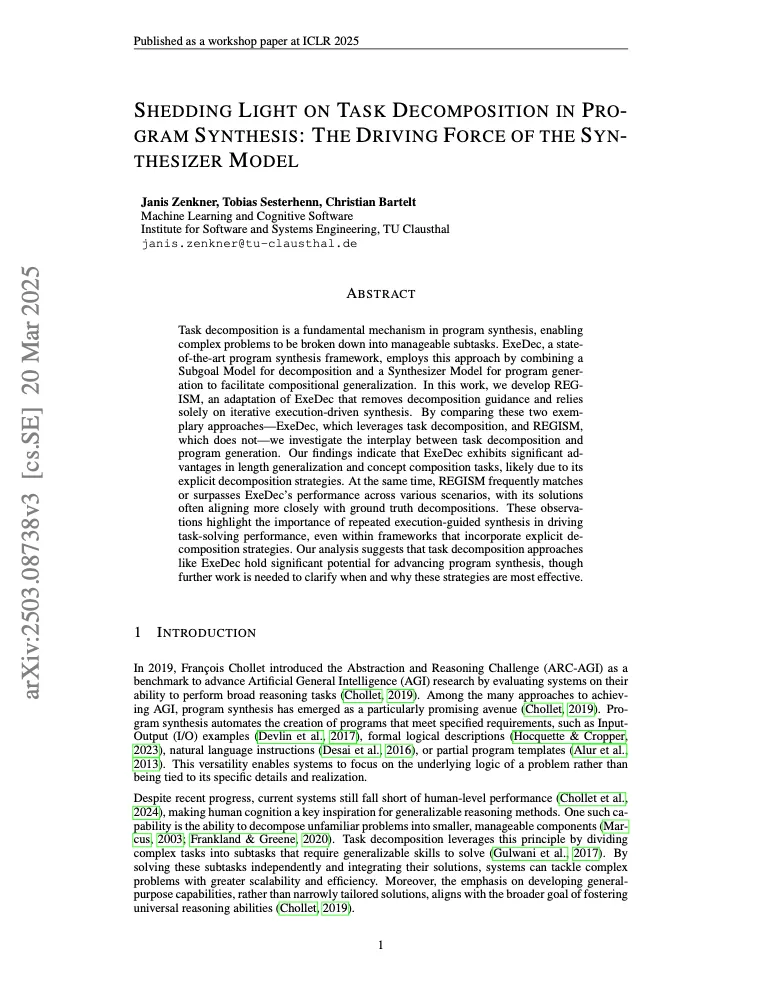
Shedding Light on Task Decomposition in Program Synthesis: The Driving Force of the Synthesizer Model

  • TU Clausthal

This paper compares ExeDec, a program synthesis framework that uses explicit task decomposition, with REGISM, its variant that relies solely on iterative execution-guided synthesis. While ExeDec performs strongly in length generalization and concept composition thanks to its decomposition strategy, REGISM often matches or exceeds it, suggesting that repeated execution can be equally or more effective in many scenarios.

Read the paper

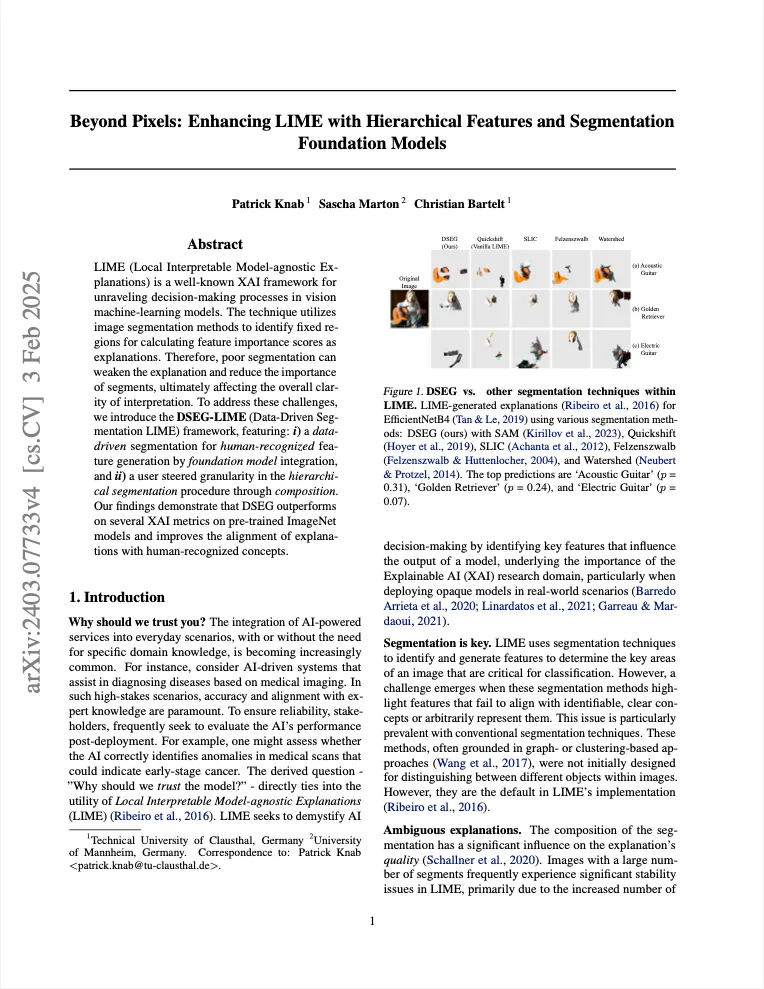
Beyond Pixels: Enhancing LIME with Hierarchical Features and Segmentation Foundation Models

  • TU Clausthal
  • University of Mannheim

The paper introduces DSEG-LIME, an improved framework for Local Interpretable Model-agnostic Explanations (LIME) in image analysis. By integrating data-driven segmentation through foundation models and enabling user-controlled hierarchical segmentation, DSEG-LIME aligns explanations more closely with human-recognized concepts and outperforms traditional methods on several explainable AI metrics.

Read the paper

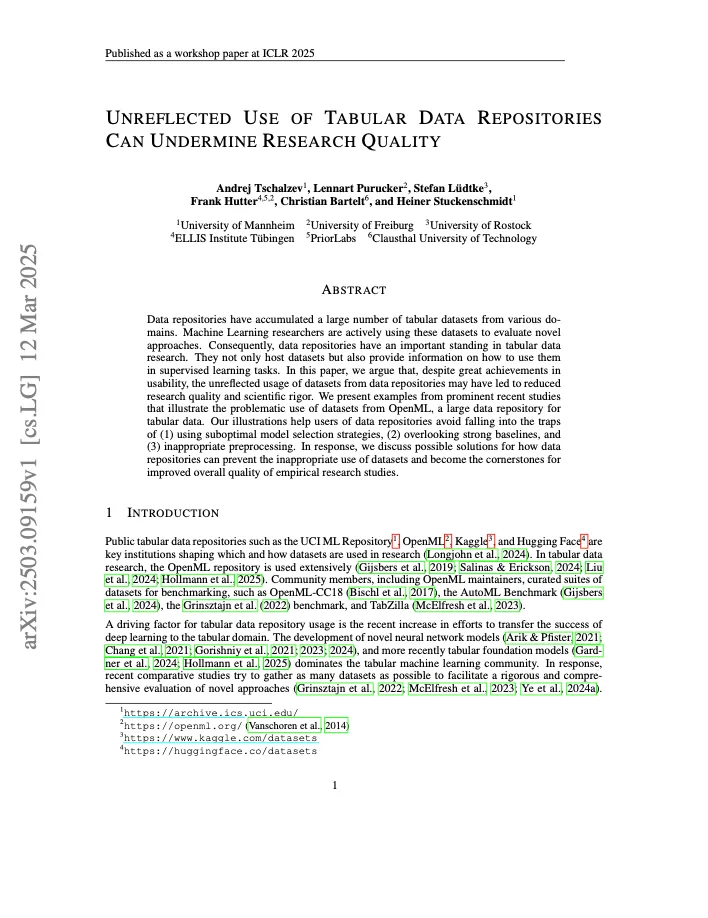
Unreflected Use of Tabular Data Repositories Can Undermine Research Quality

  • University of Mannheim
  • TU Clausthal
  • University of Rostock
  • University of Freiburg

The paper shows that indiscriminate use of datasets from repositories such as OpenML can compromise research integrity. The authors present cases illustrating issues such as suboptimal model selection, neglect of robust baselines and improper preprocessing, and propose improvements to data repository practices to strengthen empirical research standards.

Read the paper