

Three of our papers have been accepted at NeurIPS 2026
Three of our papers have been accepted at the Conference on Neural Information Processing Systems (NeurIPS, CORE Rank A*): two in the main conference, one at the FMTS workshop.
NeurIPS is one of the world’s leading conferences for machine learning and artificial intelligence. NeurIPS 2026 will be held in Sydney, Australia, from December 6 to 12, 2026, with satellite events in Atlanta and Paris from December 9 to 13.
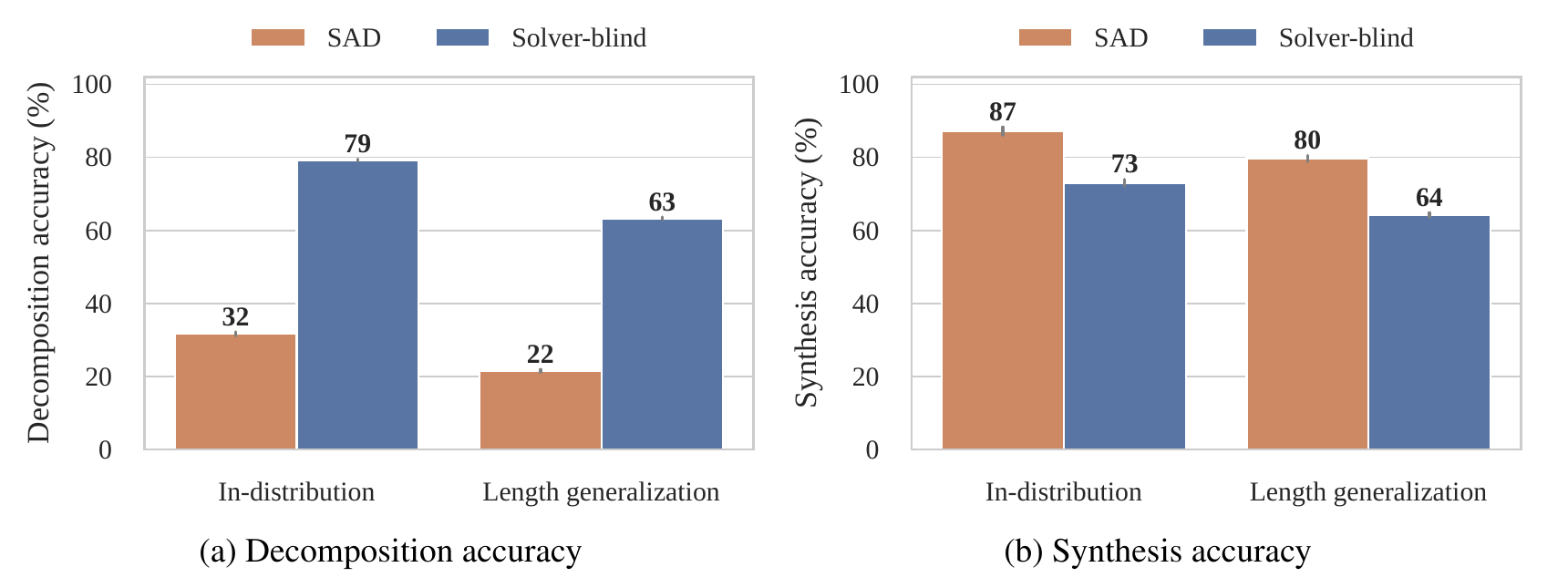
Solver-Aware Decompositions for Programming-by-Example: When Dividing Requires Knowing How to Conquer by Janis Zenkner, Tobias Sesterhenn, Tim Grams and Christian Bartelt, in the main conference. Decomposition-based Programming-by-Example splits a task into subtasks: a decomposer predicts intermediate subgoals, and a learned synthesizer generates a program for each subgoal. Execution-decomposition approaches train the decomposer to imitate ground-truth (GT) subgoals and thereby treat decomposition quality as a property of the task alone. A learned synthesizer, however, has its own inductive biases, and GT subgoals reflect how the annotator factorized the task, not what this synthesizer can solve. A decomposer that imitates them can therefore propose subgoals that are logically valid but intractable for the synthesizer.
Motivated by this observation, we propose Solver-Aware Decompositions (SAD), which keeps supervised training on GT subgoals as a structural scaffold and additionally trains the decomposer online with self-critical policy gradients against a frozen synthesizer. Each sampled subgoal is rewarded with the negative cross-entropy of the synthesizer on the target program, a continuous signal of how difficult the subtask is for this synthesizer.
Our experiments show an accuracy paradox: with the synthesizer fixed, a GT-supervised decomposer agrees more often with the GT subgoals, yet its subgoals lead to lower synthesis accuracy, although the synthesizer was trained on the same GT data. On two list-processing domains, SAD improves synthesis and task accuracy over the GT-supervised decomposer, both in-distribution and under length generalization; the same holds under zero-shot transfer to an external benchmark and for a fine-tuned language model.
Even an oracle that receives the GT subgoals at inference time, with the same synthesizer and search, fails on tasks that SAD solves, and fewer than 2% of SAD’s solutions to these tasks match the GT program. Decomposition quality is therefore not a property of the task: it depends on the synthesizer that executes the subgoals. Code, OpenReview.
Concepts in Motion: Temporal Concept Bottleneck Model for Interpretable Video Classification by Patrick Knab, Sascha Marton, Philipp J. Schubert, Drago Guggiana and Christian Bartelt, in the main conference. The paper introduces MoTIF, a transformer-based concept bottleneck model for video. A vision-language model finds object- and action-centric concepts in the training videos without manual annotation, and MoTIF models how each concept unfolds over time, so every classification can be traced back to those concepts. MoTIF improves over concept bottlenecks that treat a video as a whole and narrows the gap to black-box video models. Earlier this year, MoTIF received the Best Paper Award at the CompLearn workshop at ICML 2026 and was a spotlight paper at the XAI4CV workshop at CVPR 2026. Code, project page.
Intervenable Concept Dynamics for Video Activity Forecasting by Patrick Knab, David Steinmann, Giovanni De Felice, Felix Divo, Udo Schlegel, Wolfgang Stammer, Sascha Marton and Christian Bartelt, at the FMTS workshop. Concept bottleneck models route their predictions through concepts that people can understand. The paper introduces TRACE-CBM, which forecasts future activities in video by predicting, step by step, how those concepts evolve over time. Because the forecast runs through the concepts, it can be corrected: editing concepts fixes a quarter to a third of the initially wrong forecasts.